The Local History Plaque: What It Can and Cannot Tell You
Learn how to read a local history plaque, check its claims against other sources and notice the choices shaping what a place remembers.
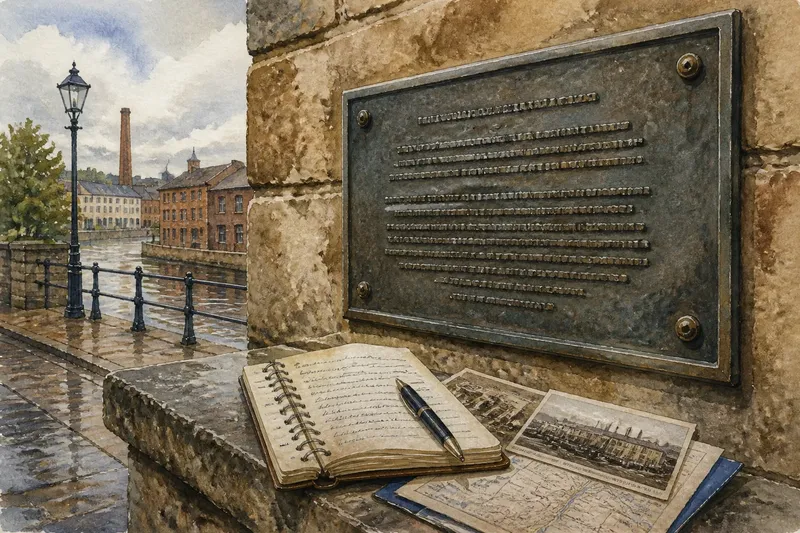
The common mistake with a local history plaque is to treat its polished wording as the whole story; the cost is mistaking a selected account for a complete one. A local history plaque records what a public body chose to commemorate, alongside the names, dates and events it states. Read those two kinds of information separately, and the metal rectangle becomes a useful starting point rather than a final authority.
Read the wording
Start with what the plaque actually says. Note the named person or event, the place, the dates, the action described and any institution credited. These are claims on the plaque’s surface. Keep them distinct from what you infer about the people who lived nearby or the significance of the event.
Pay attention to verbs. “Opened”, “built”, “served” and “was born here” make different claims. A plaque saying that a hall “served the community” does not specify who used it, who managed it or whether access was equal. The phrase gives you a subject to investigate, not an answer to every related question.
Check the physical setting too. A plaque on a library wall, station entrance or former factory may identify a connection to that site, but the building’s current use does not necessarily explain its earlier role. Look for a street name, doorway, foundation or nearby sign that helps place the wording in its surroundings.
Write down the exact sentence before paraphrasing it. That small habit makes the boundary between evidence and interpretation easier to see.
Notice the choices
A plaque has limited space, so someone has decided what deserves those lines. The choice may reflect the building’s history, a local campaign, a funding body, a public ceremony or the interests of the people who proposed it. The plaque rarely tells you the full story of that decision.
Look at emphasis and omission without assuming either proves deliberate exclusion. One plaque may name an architect and a benefactor but leave out the workers; another may honour a community organiser while saying little about the organisation around them. The wording shows what has been foregrounded. To understand why, you would need other records or accounts.
Pronouns and collective nouns deserve attention. “We”, “our town” and “the people” can make a statement sound universal, although residents may have had different experiences. Ask who is included by the wording and whether the plaque names anyone whose perspective might complicate it.
Notice what the plaque does not claim, as well. A person’s name and dates do not establish what they believed; a building’s opening date does not explain the decisions behind its construction. Absence is a prompt for a question, not automatic proof of a hidden story.
Separate fact from frame
Try a two-column note. In one column, copy claims that can in principle be checked: names, dates, locations, roles and stated events. In the other, record choices of emphasis: which person appears first, whose action is celebrated, and which wider context is left unstated. The first column concerns the plaque’s claims; the second concerns how those claims are framed.
Say you find a plaque outside a former riverside workshop stating that Mara Bell founded it and that it provided work for local residents. Treat these details as hypothetical claims. In your first column, write down the wording and the name Mara Bell; then look for a directory or local archive that might confirm the founder, and a council record that might clarify the workshop’s use. In your second column, note that Bell is named while workers are not, and that “local residents” leaves unclear who worked there. If a directory supports the founder claim but no record settles who counted as a local worker, mark the first claim as supported by that source and leave the second question open. The wording raises those questions; it does not settle them.
For another account, choose a source with a different purpose. A map may confirm where a building stood, while a council minute may record a decision about it. A family photograph can show people and surroundings, though not necessarily explain their circumstances. Compare what each source can establish instead of expecting one document to supply every missing detail.
Keep the wording exact in your notes, then mark your own interpretation clearly. That makes it easier to revise your view if another source changes the picture.
Questions about plaques?
Who put the plaque there?
Look for a named council, heritage group, institution or donor on the plaque or its base. If nobody is credited, ask the organisation responsible for the site or consult a local archive about who commissioned it.
How can I check a date?
Compare the plaque’s date with a source suited to the claim, such as a directory, map, building record or newspaper archive. If sources disagree, note the difference rather than quietly treating one version as certain.
Does a plaque prove the whole story?
No: it records a public account in compressed form, and even accurate statements can leave out context. Use it to form precise questions, then look for other evidence that addresses them.
What if the wording feels outdated?
Record the exact language and any visible date or sponsor, then ask what assumptions the wording carries. A current sign or a different account may explain later changes, but the older wording remains evidence of how the place was publicly described.
Choose another source
Choose one unfamiliar name, building or phrase from the plaque and follow just that lead. A local history society, public library catalogue or council archive may hold relevant material; a librarian can often help identify a useful collection. If you find a contradiction, keep both versions and note where each came from.
When you revisit the site, read the plaque alongside the street around it: entrances, surviving walls, changed uses and nearby names can sharpen your questions without answering them for you. A local history plaque is most revealing when you treat its stated facts as claims and its wording as a public choice. That distinction helps you remember what is written while staying alert to what the writing leaves open.