What Do We Mean When We Call Somewhere Northern?
What do we mean by northern? Separate geography, regional identity and point of view before a debate starts, so people can discuss the same place clearly.
The most common mistake in a debate about what is northern is assuming everyone means the same thing. That confusion can cost a meeting its purpose: one person is arguing about a map, another about belonging, and a third about whose needs public decisions recognise. Asking “What do we mean by northern?” before arguing about a place makes the disagreement easier to hear.
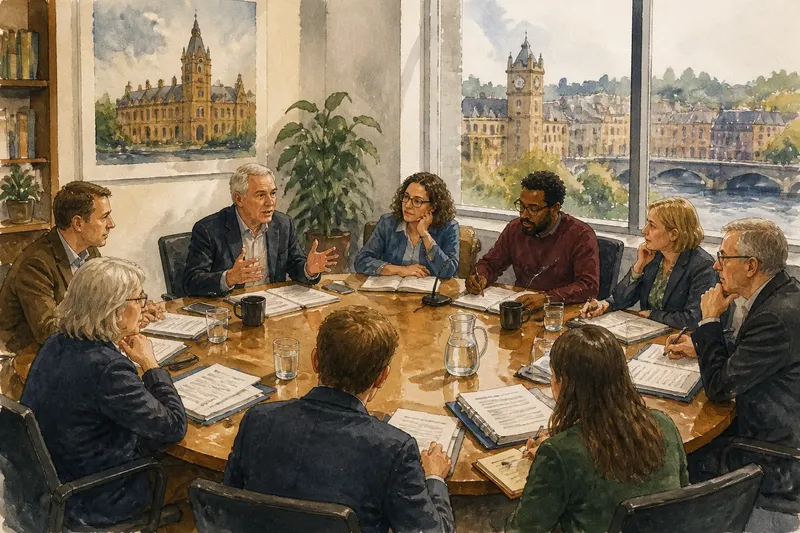
Say a fictional council is considering a shared public transport forum for the invented district of Northmere. Its proposed name, the Northern Travel Forum, draws objections before the first meeting. A coastal village says it is not included; residents of a nearby city say the name treats them as peripheral; an organiser replies that the forum is meant to address how transport decisions are made from the capital. Each group may be using “northern” sensibly, but not in the same way.
This invented situation helps separate three meanings: geographic location, regional identity and point of view. They overlap, but they are not interchangeable. The forum’s name cannot settle all three questions by itself.
Three meanings of northern
As a geographic description, “northern” locates something relative to a chosen boundary or reference point. It might mean the upper part of a country, an area north of a river, or the places served by a particular regional office. Even a map needs a frame: north of what, and for which purpose?
Regional identity describes how people understand their relationship to a place and to one another. Someone may identify strongly with a town, county, island or broader region; another person living nearby may prefer a different name. Identity can be shared without being uniform, and it can matter deeply without matching an administrative line.
A point of view is different again. Calling a policy “northern” may mean it is shaped by the priorities or experience of people who feel their region is overlooked. That claim concerns who gets to define the problem and whose account is treated as relevant. A speaker can make it without asserting that every northern resident agrees.
In Northmere, the council’s transport team uses the word as a practical catchment label. The village group hears it as a claim that their community is outside the region. The organiser uses it to challenge where decisions are made. Before deciding whether the name is fair, the meeting needs to identify which claim it is meant to carry.
Draw the map in words
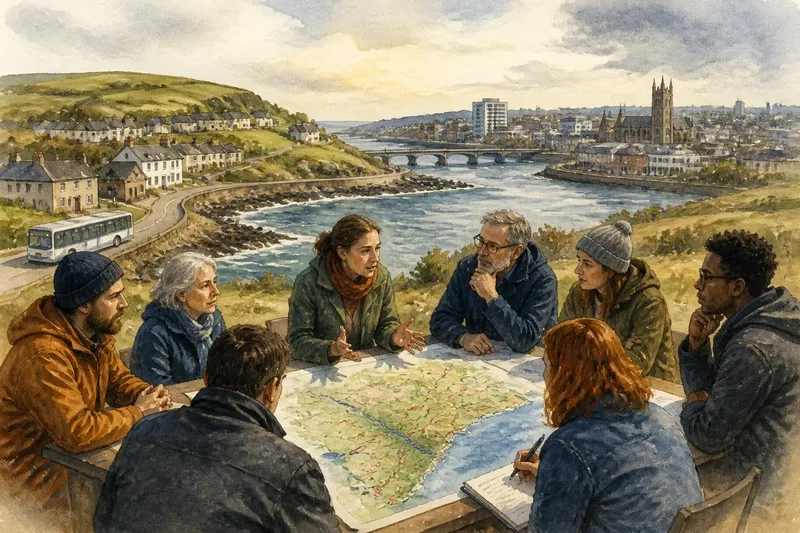
The council begins by publishing a short description of the forum’s remit. It names the districts whose transport services the forum will discuss, explains why those boundaries were chosen and says whether the area is defined by service connections, council responsibilities or another purpose. It does not pretend that this working boundary defines everyone’s regional identity.
Boundaries can change with the question. A bus route may connect a village to a city across a county line. A health service may use a different catchment. A cultural organisation may draw members from places that no transport authority would group together. Each boundary can be useful for its task without becoming the definitive outline of “the North”.
Imagine the council’s initial plan includes the city and several inland towns but omits the coast because the forum was drafted around one operator’s routes. The village group points out that residents depend on connecting services managed elsewhere. The council can then ask whether the forum’s stated transport remit requires that wider connection, rather than treating the original outline as a settled identity map.
Not every boundary is arbitrary, and a meeting cannot include everyone affected by everything. The boundary should, however, be explained in relation to the decision at hand. That lets people challenge an exclusion on relevant grounds rather than being asked to accept a label as self-evident.
Write down the reference point before debating the line.
Listen for belonging
The council invites people to describe which place names they use for themselves and which names they hear as imposed. It does not ask a resident to prove an identity through birthplace, address or accent. Those details may matter to a particular discussion, but none alone gives an outsider the right to declare how a person belongs.
In the invented Northmere case, the coastal group says “northern” is familiar, but the forum’s name makes the city sound like the centre and the coast an afterthought. City residents make a different point: they want the forum to recognise that their neighbourhoods are part of the region, not merely a service hub. These claims need not conflict. The name can be revised while the forum’s remit is made more explicit.
Regional identity also contains internal variety that a public label can hide. The same broad region may include cities, rural settlements, industrial areas, islands and coastal communities. People may share a regional attachment while disagreeing about priorities, histories or what should be called local. A useful conversation makes room for that variation instead of searching for one voice that supposedly speaks for all.
For the forum, the council changes its draft name to the Northmere Transport Forum and states that its work covers the named participating districts. The title no longer has to carry a broad claim about who belongs to the North. People can still discuss regional identity, but the meeting is not asked to settle it through a label.
Who gets to frame it?
Words about the north can also point towards unequal influence. A speaker may be asking why a regional service is planned elsewhere, why local knowledge is treated as anecdotal, or why a decision’s costs fall on communities absent from the room. In that use, “northern” is not simply a location. It marks the standpoint from which a decision is being questioned.
The phrase can help bring a neglected question into view. It can also blur differences if it suggests that a large region has one interest, or turns a specific complaint into a contest over who is authentic. The council therefore asks people to name the decision, the affected places and the missing perspective, rather than relying on “northern” to explain all three.
Suppose the invented organiser argues that route changes are being discussed without people who rely on connections between the coast and the city. That is more actionable than saying only that the plan is “not northern enough”. The organiser can identify the missing connections, ask how affected residents can contribute and invite the responsible service providers to explain the limits of their remit.
This wording does not weaken the regional argument. It makes its point more exact: the issue is not whether a place passes an identity test, but whether the decision accounts for the people and connections it affects.
When does the label help?
Is northern a fixed boundary?
Not by itself. A boundary depends on the purpose, reference point and institution using it, so a useful description names those things rather than presenting one line as universal.
Can someone claim a northern identity?
People can describe their own attachments, and those attachments need not be identical across a region. A public discussion should hear that variety rather than appointing one speaker as the official representative of everyone.
Does northern always mean overlooked?
No. It can be a straightforward location, a source of belonging or a way to question how decisions are framed. The speaker’s intended meaning and the issue under discussion help distinguish those uses.
What should a meeting ask first?
Ask whether the word describes a geographic area, a community identity or a standpoint on the decision. Then ask what explanation would make that meaning clear to everyone present.
Reach a usable result
By the time the Northmere forum is ready to meet, the council has not settled what “northern” means for every resident. It has done something more appropriate to its task: specified the area covered, made space for different attachments and turned a broad challenge about regional voice into questions about participation and transport links.
The walk-through offers a simple sequence for other public discussions. First, identify whether the word is being used geographically, as an identity or as a point of view. Next, state the relevant boundary or claim in concrete terms. Then listen for who feels included, who feels left out and what decision is actually under debate. Finally, choose language that describes the task without pretending to resolve every question of belonging.
That sequence will not remove disagreement. It can stop people talking past one another and give a meeting something solid to work with: a named area, a clear account of identity claims and a specific question about whose perspective shapes the decision.
When you hear a proposal described as northern, ask what the word is doing in that sentence. The answer may reveal whether the next conversation belongs on a map, in a discussion of belonging, or at the table where decisions are made.