When a Familiar Custom Changes Without Disappearing
Learn how to describe a familiar custom as it changes: trace its purpose, participants and setting without mistaking adaptation for loss.
The common mistake when a familiar custom changes is to call it either untouched or finished. That shortcut can make people who still take part feel invisible, while obscuring what has genuinely shifted. To describe a custom changing without disappearing, begin with what people do now, then compare its purpose, participants and setting with what they remember or can document.
Choose the custom
Start with one recognisable practice, not a sweeping claim about a whole town or region. It might be a gathering, a seasonal observance, a shared meal or a routine linked to a local institution. Keep the name people use for it, but treat that name as a starting point rather than proof that every detail has stayed the same.
Set a modest boundary. Are you describing the event itself, the preparation around it, or the ways people talk about it? A custom can persist in one part and change in another. If a neighbourhood still holds an annual gathering but no longer prepares for it collectively, those are connected practices, not necessarily one unchanged whole.
Say what you are looking at in plain language: “the annual gathering and the activities around it”. This gives readers something specific to follow.
Establish the present
Before comparing accounts of the past, write down how the custom currently works. Note the setting, who takes part, what happens, and what people say the occasion is for. Look for ordinary details: who invites others, which spaces are used, whether newcomers are welcomed, and what participants expect to happen.
Separate observation from interpretation. “The gathering now takes place in the community hall” is a description. “People have become less attached to the custom” is an interpretation, and it needs evidence from what participants say or do. Even a detail that seems self-explanatory may mean different things to different people.
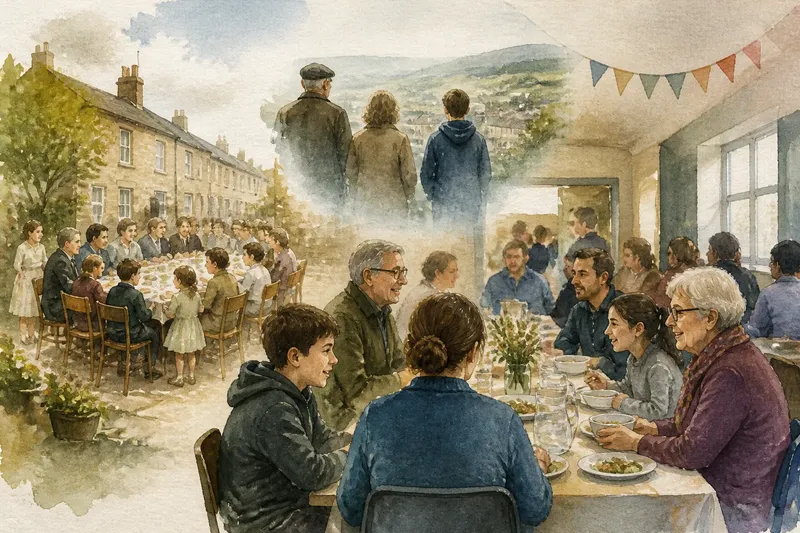
Imagine you are describing a neighbourhood meal that has moved from a street to a hall. You might record that residents still bring food, while the hall’s booking arrangements shape who can organise the event. That account describes visible changes without deciding in advance whether the meal has lost its meaning.
Ask about purpose
Next, ask what participants believe the custom does. It may be a way to meet neighbours, honour a shared memory, welcome newcomers, mark a season, raise funds or simply enjoy an occasion together. Several purposes can coexist, and people may disagree without one account cancelling the others.
Use open questions: “What makes this feel like the same occasion to you?” or “What do you most want to keep?” Ask people who organise it, people who attend occasionally and people who have stopped coming, if they are willing to talk. Their answers can reveal that a practice has acquired a new purpose while retaining an older one.
Be careful with inherited explanations. Someone may say the custom has “always been for” a particular reason, but that phrase can express present attachment as much as a verifiable account of its origins. Record it as that person’s understanding unless you have grounds to make a broader claim.
Trace participation
Then consider who takes part and who shapes the event. Ask whether the organisers, attendees, volunteers, families or local groups have changed. Notice differences in access and influence: being present is not always the same as deciding what happens.
Do not reduce participation to a single story of decline or expansion. A custom may involve fewer people in one role and more in another. It may also become more open to some residents while remaining difficult for others to join. Describe the particular shift you can support, and avoid treating any group as a single voice.
Ask participants how they came to be involved, what makes it possible for them to take part, and whether anything puts them off. These questions can bring practical barriers into view without assuming that a change in attendance means a change in affection.
Compare settings
Now look at where the custom happens and what the setting allows. A move from a home, street or outdoor space to a school, hall or online gathering can alter the atmosphere, access and responsibilities. It can also make an event easier to organise or bring new people into it. Neither effect, by itself, tells you what the custom means.
Consider what changed along with the location. Are there new rules, booking arrangements, equipment or hosts? Has the event become easier for some people to attend and harder for others? Keep the account grounded in concrete details, rather than treating a building or platform as a symbol with one fixed meaning.
When the setting affects access or safety, describe the issue in general terms and defer to the venue’s guidance and relevant local requirements.
Describe change carefully
Once you have these pieces, describe continuity and change side by side. A useful account might say that a custom keeps its familiar name and gathering, while its organisers, purpose or location have shifted. Be precise about which parts remain recognisable and which are different. “Unchanged” and “lost” are not the only available descriptions.
Keep memories distinct from records. A remembered detail can tell you how an event felt or what it meant to someone; a programme, notice or set of minutes may show how it was arranged. Each kind of account answers different questions. If accounts conflict, say so rather than quietly choosing the version that makes the neatest story.
For a clear comparison, organise your notes under four prompts:
- Purpose: What do participants say the custom is for now, and what earlier purpose do they recall?
- People: Who participates, organises and makes decisions?
- Setting: Where does it happen, and what does that place make possible?
- Practice: What actions or recognisable features continue, and what has altered?
Use the prompts to find differences, not to force every custom into the same account.
Questions about customs?
Can a custom keep its name and still change?
Yes. A name can remain familiar while the purpose, participants or setting shifts. Describe the continuity and the changes separately rather than using the name as evidence that nothing has altered.
How can I avoid calling a change a loss?
Ask participants what they value and what has become different, then describe both in concrete terms. A change may involve loss for some people and new possibilities for others.
What if people remember the custom differently?
Keep the accounts attributed to the people who gave them, and note where they differ. Memory can reveal meaning and belonging without settling every question about how an event was organised.
How do I write about a custom I do not take part in?
Make your standpoint clear and listen to people with different relationships to the practice. Avoid presenting one organiser or regular attendee as the voice of everyone involved.
Write the account
Draft the description from the evidence you have gathered, using verbs that name actions: “hosts”, “welcomes”, “remembers”, “raises” or “meets”. Explain which features carry recognition for participants and where the arrangement has changed. If you cannot establish an earlier detail, say that it is unclear rather than filling the gap with a confident-sounding origin story.
Read the draft once for balance. Does it acknowledge what continues without suggesting that continuity means sameness? Does it identify change without implying that a custom has vanished? Have you made room for participants who experience the practice differently?
A careful description lets a familiar custom remain recognisable without freezing it in an imagined past. When a familiar custom changes without disappearing, the most useful account is the one that tells readers what people still do, what they now do differently, and whose understanding is guiding that description.